Understanding Register Files: Their Role in Computing
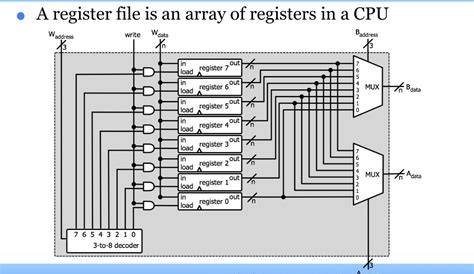
A register file is a small, high-speed storage area within a CPU that temporarily holds data needed for computation. It enables rapid access to registers, which are essential for executing instructions and managing operations efficiently.
What is a register file?
A register file consists of a collection of registers, which are small storage locations within the CPU that hold data temporarily. These registers serve various purposes, such as holding operands for operations, storing intermediate results, or maintaining control information. A typical register file includes general-purpose registers, special-purpose registers, and status registers. For example, general-purpose registers can hold integer values during calculations, while special-purpose registers may serve specific functions like program counters or instruction registers.
How do register files function in a CPU?
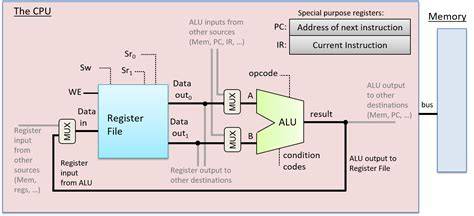
Register files play a critical role in CPU operation, facilitating data transfer between the control unit and the arithmetic logic unit (ALU). When the CPU executes an instruction, it retrieves data from the register file to perform calculations. Accessing registers is much quicker than accessing memory, which enhances overall processing speed. For instance, if an instruction requires adding two numbers, the CPU loads these numbers from the register file into the ALU, performs the addition, and then stores the result back into the register file. This efficient operation helps maintain high processing speeds.
Common misconceptions about register files
Many people mistakenly believe that register files are the same as cache memory or main memory. In reality, register files are much smaller and faster, designed for immediate data access during computation rather than long-term storage. Another common misunderstanding is that all registers function identically; however, there are various types of registers, each serving distinct purposes, such as holding data, addresses, or control information.
Why are register files important for performance?
Register files significantly influence CPU performance by providing quick access to data. The faster a CPU can retrieve and process information, the more efficient it becomes. A well-designed register file minimizes delays associated with fetching data from slower memory types, such as RAM. This efficiency allows the CPU to execute instructions swiftly, which is vital for performance-sensitive applications like gaming, data processing, and scientific simulations.
Real-world applications of register files
Register files are found in various computing systems, including personal computers, servers, and embedded systems. For example, in a personal computer, the CPU utilizes register files to manage tasks such as running applications and processing user inputs. In embedded systems, such as those in appliances or vehicles, register files control operations and maintain real-time data processing, ensuring prompt responses to user commands and environmental changes.
Conclusion
Understanding register files is essential for grasping how CPUs operate and manage data efficiently. As you study computer architecture, consider how different types of registers and their organization can impact overall system performance.